
Napoleon Looms Large
History serves Music

As we’ve moved through a season of Cadenza Circle conversations, one unexpected byproduct has been the emergence of patterns. In going deeper, certain non-musical figures begin appearing again and again, almost like hidden companions to the music itself. They seem to hold tremendous influence over the music – mostly because they held tremendous influence of the music’s creators.
Perhaps the most plainsight example of this is what we see from the relationship between Dmitri Shostakovich and Josef Stalin. Stalin dominated the psyche of the composer, and his music very obviously reflects it.
In exploring the composers of the late nineteenth century, the first figure we quickly notice is the gravitational pull of Friedrich Nietzsche. His ideas and language are dominant threads through the worlds of composers like Richard Strauss and Gustav Mahler. His questions of heroism, transcendence, morality, individuality, suffering/salvation, and meaning are all reflected in their music with remarkable frequency.
But another recurring figure emerged from our recent discussions, and in some ways he may be even more surprising: Napoleon Bonaparte.
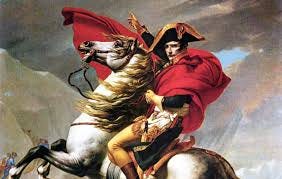
The deeper one travels into nineteenth century music, the more Napoleon seems to linger in the background. Sometimes directly, as in Beethoven’s Eroica Symphony or Tchaikovsky’s 1812 Overture. Other times indirectly, as a kind of psychological atmosphere shaping the world in which composers lived. Again and again, we get the sense that Napoleon was more than a political figure, he was a force that occupied the minds of Europe itself.
If Nietzsche is an intellectual presence, Napoleon is an historical one.
Napoleon arrived into the lives of our composers – and all citizens - through war, revolution, nationalism, political upheaval, and the reshaping of Europe itself. He dominated the daily headlines, and surely people had strong opinions.
From roughly 1800 to 1815, it is difficult to imagine another figure who occupied the European mind more completely. Borders shifted constantly. Armies moved across the continent. Families watched sons disappear into military service, and, sadly, demise. Economies bent under blockade and war. Monarchies collapsed, reformed, and fought for survival. In cities from Vienna to Moscow, Napoleon was the central fact of political and cultural life.
Music, or more clearly stated, musicians absorbed this reality almost immediately. And no composer illustrates this relationship more famously than Ludwig van Beethoven.
Like many intellectuals of his generation, Beethoven initially viewed Napoleon as the embodiment of revolutionary ideals born out of the French Revolution. Liberty. Merit. The overthrow of royal power. Beethoven admired him deeply enough that he originally dedicated his Third Symphony to Napoleon himself.
Then came 1804.
When Napoleon crowned himself emperor, Beethoven reportedly flew into a rage and tore the title page from the manuscript. The work would eventually become the Eroica Symphony, now carrying the subtitle “Composed to celebrate the memory of a great man.”
“So he is no more than a common mortal! Now, too, he will tread under foot all the rights of man, indulge only his ambition; now he will think himself superior to all men, become a tyrant!”
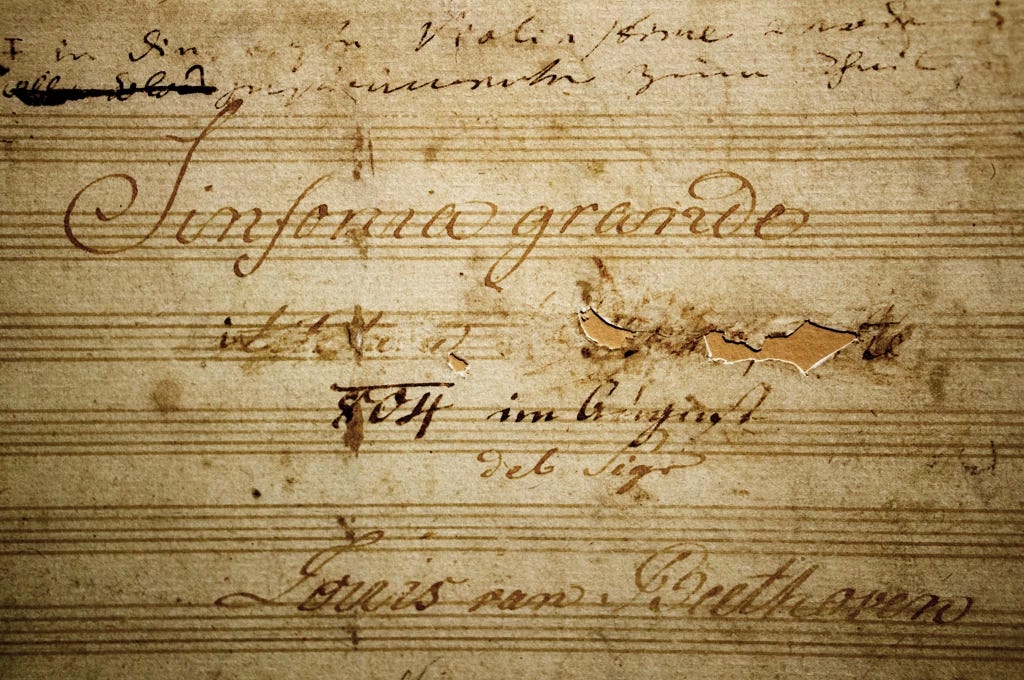
Whether entirely factual or somewhat mythologized over time, the story has endured because it captures something larger than biography. Napoleon had become, for Beethoven and many others, a symbol of disillusionment. The revolutionary hero had transformed into another emperor.
Napoleon would continue to echo through Beethoven’s world. Even the Seventh Symphony, often discussed as pure rhythm and energy, exists within the broader atmosphere of the Napoleonic Wars. Its premiere formed part of a benefit concert for wounded soldiers after the Battle of Hanau, alongside another [more obviously named] Beethoven piece, Wellington’s Victory. War sat close to the music, even when the symphony itself contains no explicit battlefield narrative.
Looking beyond Beethoven, one of the more surprising discoveries in tracing Napoleon through music is how often he appears indirectly.
In Puccini’s great 1899 opera Tosca, Napoleon never walks onstage, yet his presence governs the opera’s political tension. The plot unfolds against the backdrop of the Battle of Marengo, and the name Bonaparte finds its way into the libretto itself. News of Napoleon’s victory suddenly transforms the fate of the characters themselves. Even absent, he shapes the emotional climate of the drama, pitting pro-Napoleon revolutionaries (Cavaradossi) against Italy’s legacy papal state (Scarpia).
By the time Pyotr Ilyich Tchaikovsky composed the 1812 Overture decades later, Napoleon had already passed largely into mythology. He appears almost as an archetype of overwhelming historical force. And still that milestone in 1812 – the Russian army turning Napoleon back after years of his triumph, turning the tide ultimately for good, found its way into being a muse for Tchaikovsky’s music. The music depicts invasion, resistance, destruction, and survival on a civilizational scale, and even gives us obvious clues such as the theme from La Marseillais. The figure of Napoleon hovers over the piece even when he himself remains unseen.
That may be the most fascinating aspect of all. Napoleon repeatedly enters music without entering the stage. He exists in memory, politics, fear, triumph, and collective consciousness. He becomes part of the emotional architecture of nineteenth century art itself. We see how the music gives us glimpse into history, and how history shaped the music.